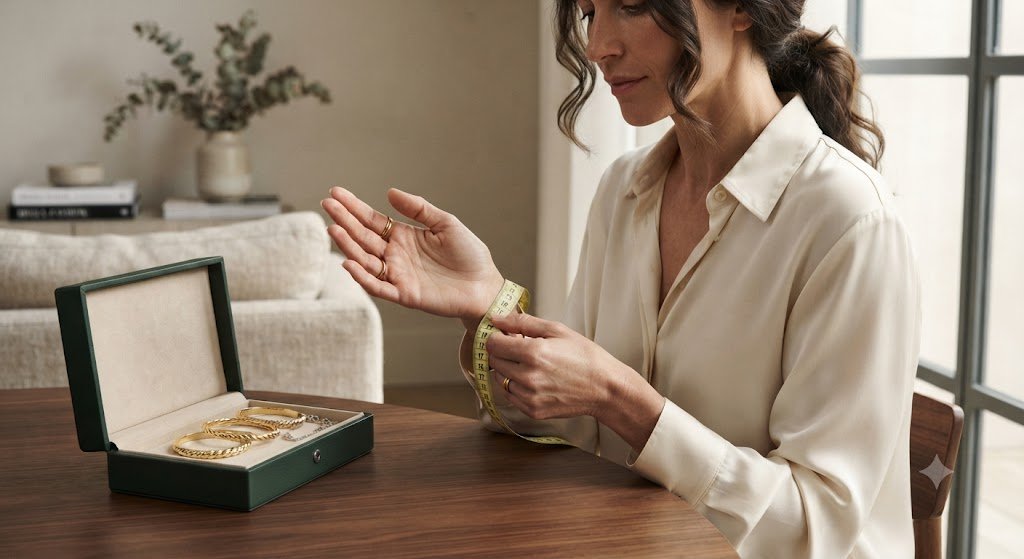
Buying a beautiful bangle or rigid bracelet online is exciting—until it arrives and won’t slide over your hand or feels so loose that it slips off your wrist. Unlike chain bracelets, which usually feature adjustable clasps, rigid bangles must pass over the widest part of your hand before resting comfortably on your wrist. That makes choosing the correct size especially important.
Fortunately, measuring for a bangle at home is simple and only takes a few minutes. With a flexible measuring tape or even a piece of string, you can determine the size that offers both comfort and security. Understanding the differences between closed bangles and cuff bracelets also helps ensure you select the right style for your needs.
This guide will walk you through the entire measuring process, explain how to convert your measurements into the correct bangle size, and share practical tips for achieving the perfect fit every time.
Why Measuring for Bangles Is Different
Unlike bracelets with clasps, a rigid bangle cannot be opened before putting it on. Instead, it must slide over your hand before settling comfortably around your wrist.
For this reason, the widest part of your hand—not your wrist—is the measurement that matters most.
A bangle that’s too small may never pass over your hand, while one that’s too large can constantly slide up and down your arm or even fall off during everyday activities.
Taking accurate measurements before purchasing helps you avoid unnecessary returns and ensures a more comfortable wearing experience.
Method 1: The Closed-Hand Measurement
The easiest and most reliable method is measuring your hand while it’s positioned exactly as it would be when putting on a bangle.
What You’ll Need
- A flexible measuring tape
- Or a piece of string and a ruler
- A mirror (optional)
Step-by-Step Instructions
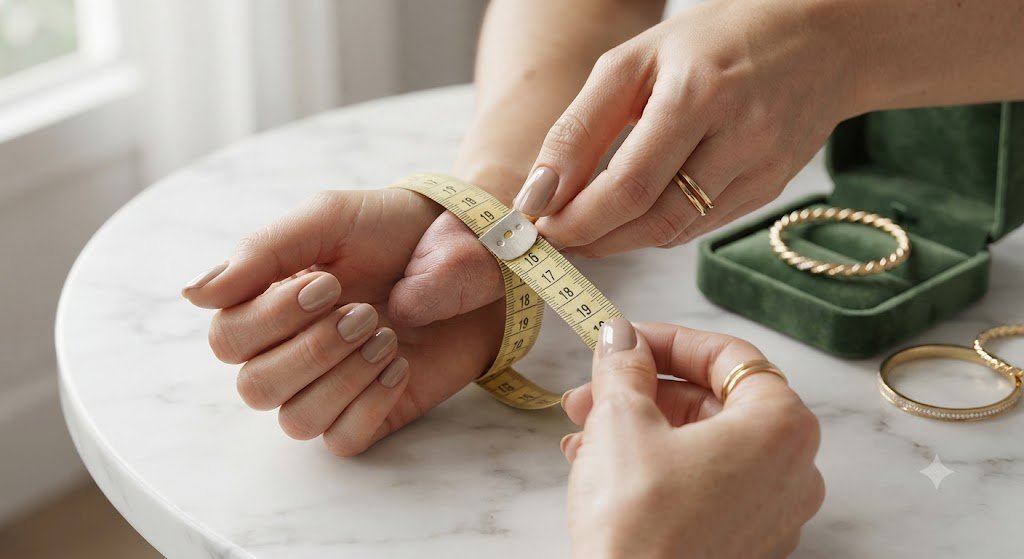
- Bring your thumb across your palm as if you were about to slide on a bracelet.
- Keep your fingers together naturally without squeezing too tightly.
- Wrap the measuring tape or string around the widest part of your folded hand.
- Make sure the tape sits snugly without compressing your hand.
- If using string, mark where the ends meet.
- Lay the string flat and measure its length with a ruler.
- Record the circumference in both inches and centimeters if possible.
This measurement represents the minimum inner circumference your bangle should accommodate.
Converting Your Measurement to Bangle Size
Once you’ve measured your hand, you’ll need to choose the appropriate internal diameter for your bangle.
While sizing standards may vary slightly between brands, the following chart provides a helpful general reference.
General Bangle Size Guide
| Bangle Size | Hand Circumference | Approximate Inside Diameter |
|---|---|---|
| Small | 7–7.5 inches (18–19 cm) | About 2.25 inches (5.7 cm) |
| Medium | 7.5–8 inches (19–20.5 cm) | About 2.5 inches (6.3 cm) |
| Large | 8–8.5 inches (20.5–21.5 cm) | About 2.75 inches (7 cm) |
Because sizing systems vary among manufacturers, always compare your measurements with the retailer’s own sizing chart before ordering.
The Mirror Test
Measurements provide an excellent starting point, but seeing how a bracelet fits visually is equally important.
If you already own a similarly sized bangle, try it on while standing in front of a mirror.
Ask yourself:
- Does it slide over the hand comfortably?
- Does it stay near the wrist during normal movement?
- Does it rotate naturally without feeling loose?
- Does it feel secure when your arm hangs naturally?
A properly fitted bangle should move slightly but shouldn’t constantly slide over your hand or feel at risk of falling off.
Comfort and security should always be balanced.
Closed Bangles vs. Cuff Bracelets
Not all rigid bracelets fit in exactly the same way.
Understanding the difference between these two styles makes choosing the right size much easier.
Closed Bangles
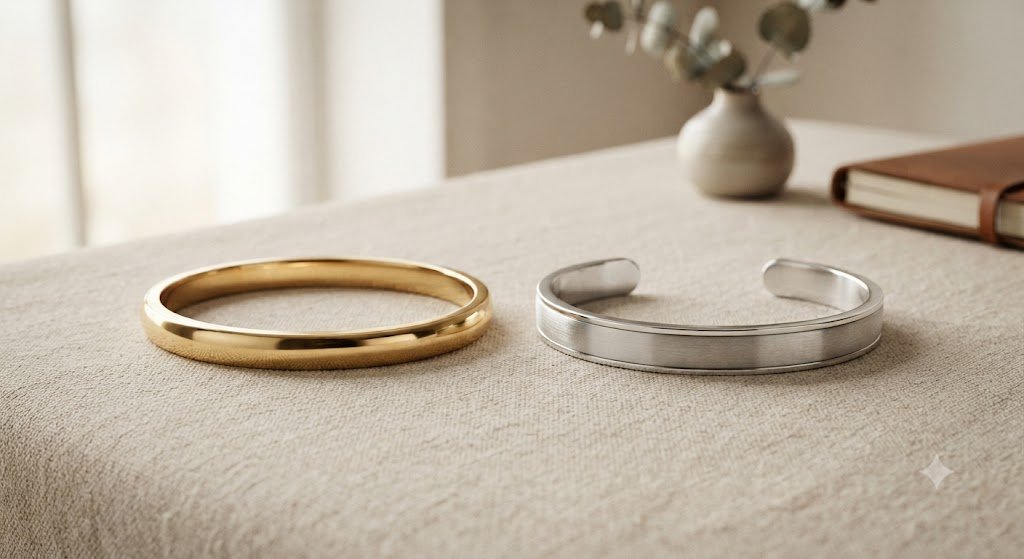
Traditional bangles form a complete circle with no opening.
Because they cannot expand, accurate hand measurements are essential.
Always prioritize your hand circumference rather than your wrist measurement when selecting this style.
Cuff Bracelets
Cuff bracelets feature a small opening that allows the bracelet to slip onto the wrist more easily.
Some cuffs also offer slight flexibility, allowing for minor adjustments after purchase.
Although measuring your wrist remains helpful, cuff bracelets generally provide more sizing flexibility than closed bangles.
However, avoid bending cuffs excessively, as repeated adjustments may weaken the metal over time.
Factors That Influence the Perfect Fit
Finding the right size isn’t only about measurements.
Several additional factors can affect how a rigid bracelet feels during everyday wear.
Wrist Shape
People with smaller wrists often prefer a closer fit to prevent unnecessary movement.
Those with larger wrists may appreciate a little extra room for comfort.
Bracelet Width
Wide bangles naturally feel tighter than narrow ones, even when the internal diameter is identical.
If you’re choosing an especially wide bracelet, slightly more room may improve comfort.
Personal Style
Some people enjoy bangles that move freely along the forearm, while others prefer bracelets that remain close to the wrist.
Neither approach is right or wrong—the best fit depends on your personal preference.
What If the Bangle Doesn’t Fit?
Even careful measurements can’t guarantee a perfect fit every time.
Fortunately, many reputable jewelers offer exchange or return policies that make finding the correct size easier.
If your bracelet doesn’t fit:
- Review the retailer’s exchange policy.
- Compare your original measurements again.
- Choose the next appropriate size if necessary.
- Contact customer service if sizing information seems unclear.
Never Force a Rigid Bangle
If a closed bangle refuses to pass over your hand, do not force it.
Applying excessive pressure may:
- Bend precious metals.
- Distort the bracelet’s shape.
- Damage gemstone settings.
- Create permanent structural weakness.
It’s always better to exchange the bracelet than risk damaging it.
Tips for Buying Bangles Online
Shopping online becomes much easier when you prepare in advance.
Before completing your purchase, remember to:
- Measure your hand rather than your wrist.
- Compare your measurements with the retailer’s sizing chart.
- Confirm whether the bracelet is a closed bangle or a cuff.
- Read customer reviews regarding sizing.
- Check the return and exchange policy.
- Consider bracelet width when selecting a size.
- Avoid guessing based solely on photographs.
These simple precautions greatly increase the likelihood of receiving a bracelet that fits comfortably from the start.
Common Sizing Mistakes to Avoid
Many sizing problems happen because of small oversights.
Try to avoid these common mistakes:
- Measuring only your wrist.
- Holding your hand too tightly while measuring.
- Ignoring the bracelet’s width.
- Assuming all brands use identical sizing.
- Forcing a bracelet onto your hand.
- Forgetting to check the retailer’s size guide.
Taking a few extra minutes to measure carefully can save considerable time and frustration later.

Final Thoughts
Finding the perfect bangle size doesn’t have to be difficult. By measuring the widest part of your hand, comparing your results with a reliable sizing chart, and understanding the differences between closed bangles and cuff bracelets, you can shop online with far greater confidence.
Remember that comfort is just as important as appearance. A well-fitting rigid bracelet should slide over your hand without excessive force, rest securely on your wrist, and feel comfortable throughout the day without constantly slipping or pinching.
Before purchasing your next bangle, take a few minutes to follow this simple measuring guide. A little preparation will help you choose a bracelet that fits beautifully, feels comfortable, and becomes a favorite piece in your jewelry collection for years to come.
You Might Also Like
- Anklet Sizing Guide and Measurement: How to Measure and Choose the Perfect Fit
- Jewelry Condition Reports and Certifications Resale Value: Why Documentation Matters in the Secondary Market
- How to Measure Your Wrist for Bracelet Size: The Complete Guide to Link Bracelets and Chains
