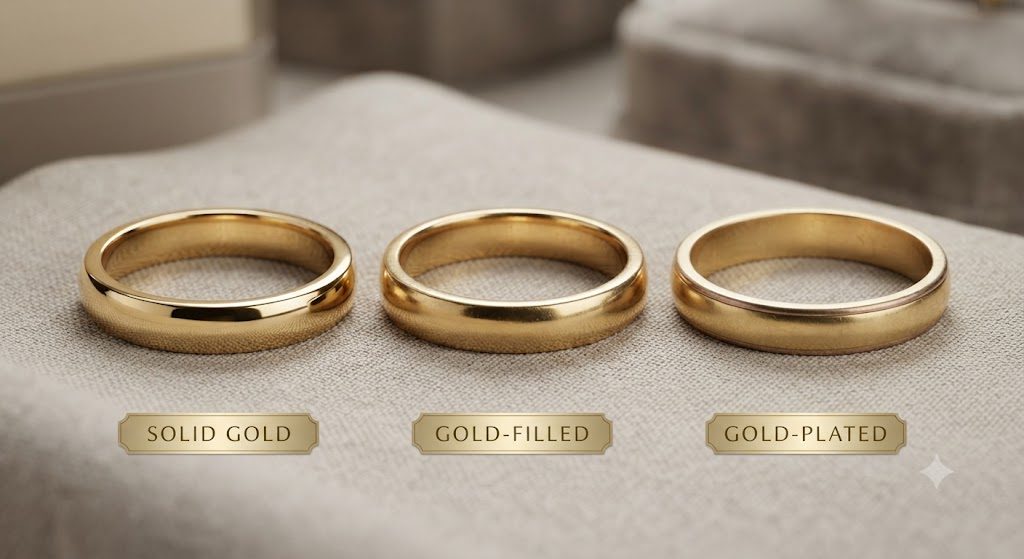
Understanding the Different Types of Gold Jewelry
Gold jewelry has long been a symbol of elegance, quality, and timeless style. Whether you’re shopping for a necklace, bracelet, ring, or earrings, you’ll likely come across terms like solid gold, gold-filled, and gold-plated. While these pieces may look similar at first glance, they differ significantly in durability, value, and price.
Knowing the difference can help you choose jewelry that fits both your lifestyle and your budget. In this guide, we’ll explain how each type is made, compare their strengths and weaknesses, and help you decide which option is right for you.
Quick Answer:
Solid gold offers the best durability and long-term value because it contains gold throughout the entire piece. Gold-filled jewelry features a thick bonded layer of real gold, making it an excellent choice for everyday wear at a more affordable price. Gold-plated jewelry has a thin gold coating over a base metal, making it the most budget-friendly but also the least durable.
What Is Solid Gold?
Despite its name, most solid gold jewelry isn’t made from pure gold. Pure 24K gold is extremely soft, so manufacturers mix it with other metals such as silver, copper, or zinc to improve its strength.
The amount of pure gold is measured in karats (K):
- 10K: 41.7% gold – very durable and affordable.
- 14K: 58.3% gold – the most popular choice for everyday jewelry.
- 18K: 75% gold – richer color with a luxurious appearance.
- 24K: 99.9% gold – beautiful but too soft for daily wear.
Pros
- Very durable
- No coating to peel or flake
- Can be polished repeatedly
- Ideal for daily wear
- Retains value well
Cons
- Highest price
- Softer at higher karats
Solid gold is the best choice if you’re looking for jewelry that can last for decades or even generations.
What Is Gold-Filled Jewelry?
Gold-filled jewelry is made by permanently bonding a thick layer of real gold to a base metal—usually brass—using heat and pressure.
Unlike gold plating, the gold layer is much thicker. In the United States, gold-filled jewelry must legally contain at least 5% real gold by weight, making it significantly more durable than gold-plated pieces.
Pros
- Much more durable than gold-plated jewelry
- Holds up well to everyday wear
- More affordable than solid gold
- Excellent value for money
- Suitable for frequent use
Cons
- Costs more than gold-plated jewelry
- Cannot be polished as aggressively as solid gold
If you want jewelry that looks luxurious without paying the price of solid gold, gold-filled is often the best balance between quality and affordability.
What Is Gold-Plated Jewelry?
Gold-plated jewelry is created by applying a very thin layer of real gold over a base metal through an electroplating process.
Because the gold coating is only a few microns thick, it gradually wears away with regular use.
Pros
- Most affordable option
- Great for fashion trends
- Wide variety of styles
- Beautiful appearance when new
Cons
- Can fade over time
- More sensitive to water, sweat, and perfumes
- Better suited for occasional wear
Gold-plated jewelry is a great choice if you enjoy changing your accessories frequently or want stylish pieces without making a large investment.
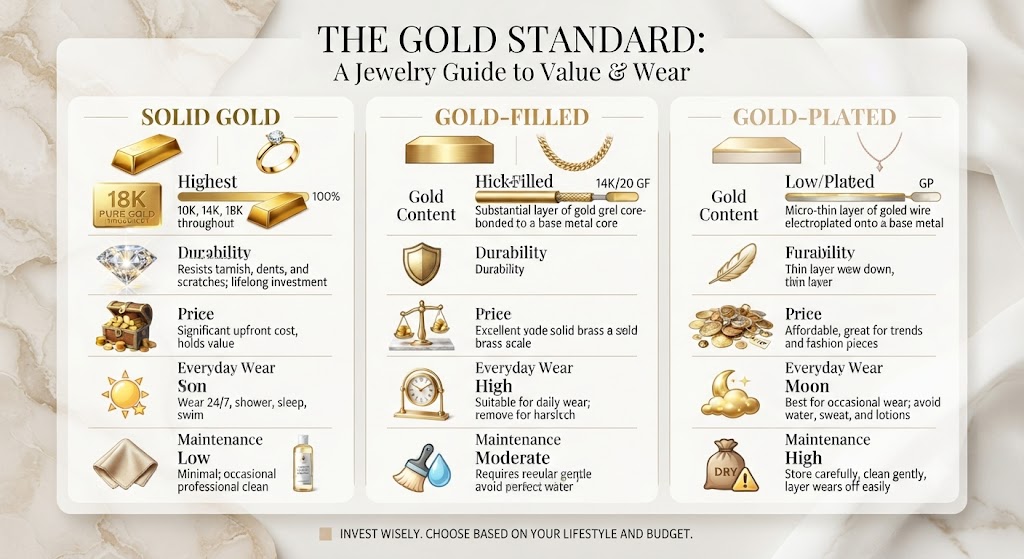
Comparison Table
| Feature | Solid Gold | Gold-Filled | Gold-Plated |
|---|---|---|---|
| Real Gold | Throughout the entire piece | Thick bonded layer | Thin surface coating |
| Durability | ★★★★★ | ★★★★☆ | ★★☆☆☆ |
| Everyday Wear | Excellent | Very Good | Occasional |
| Peeling or Flaking | No | Very Unlikely | Possible |
| Price | $$$$ | $$ | $ |
| Best For | Long-term investment | Daily wear | Fashion trends |
How to Identify Each Type
When shopping online or in stores, look for quality markings.
Common stamps include:
- 10K, 14K, 18K, 24K – Solid gold
- GF – Gold-filled
- GP – Gold-plated
- GEP – Gold electroplated
- HGE – Heavy gold electroplate
Reading product descriptions carefully can help you understand exactly what you’re buying.
Which One Should You Choose?
Choose Solid Gold If You:
- Wear jewelry every day.
- Want a lifetime investment.
- Prefer minimal maintenance.
- Value long-term durability.
Choose Gold-Filled If You:
- Want excellent quality at a lower price.
- Plan to wear your jewelry frequently.
- Need a balance between durability and affordability.
Choose Gold-Plated If You:
- Love trying new fashion trends.
- Have a limited budget.
- Wear jewelry mainly on special occasions.
- Enjoy updating your collection often.
There isn’t a single “best” option—only the one that best fits your needs.
Choosing by Situation
The comparison above covers the basics. The situations below show how the three types behave in specific kinds of use, so you can match the construction to how the piece will actually be worn.
Buying for Everyday Wear
If a piece is going on your hand or wrist daily, it needs to hold up to friction, moisture, and the occasional knock. Gold-filled jewelry is built for exactly this: the gold layer is bonded to the base metal with heat and pressure rather than a thin electroplated coating, so it tends to hold up well through years of regular use. Gold-plated pieces can still work for daily wear, but expect the surface layer to thin faster and eventually need replating.
Buying on a Tight Budget
Gold plated is the most affordable of the three by a wide margin, since only a thin layer of gold is used over a base metal. It’s a reasonable choice for pieces you plan to wear occasionally or replace as trends change, rather than keep for years. If your budget allows a bit more, gold-filled sits in between plated and solid gold — a higher upfront cost than plating, but far less than solid gold, with meaningfully better durability than a plated piece.
Buying for Sensitive Skin or Metal Allergies
Because gold-plated jewelry has only a thin surface layer, the base metal underneath — which can include nickel — becomes more likely to contact skin as that layer wears down, which is a common trigger for reactions. Solid gold, particularly at higher karats, and gold-filled pieces made with a nickel-free base are generally safer bets for reactive skin, since there’s more gold between the base metal and your skin, or no reactive base metal at all in the case of high-karat solid gold. If you’re dealing with an active reaction to jewelry you already own, our guide on fixing jewelry that’s irritating your skin covers what to do before replacing anything.
Buying an Engagement Ring or Heirloom Piece
For jewelry meant to last decades or get passed down, solid gold is the standard choice. Because the gold runs all the way through the piece rather than sitting on the surface, it can usually be resized, repaired, and repolished several times over its lifetime without exposing a different metal underneath. Neither gold-filled nor gold-plated jewelry is built for this kind of long-term structural wear and repeated resizing.
Buying Jewelry You’ll Wear in the Shower or Pool
Gold-plated jewelry is the most sensitive of the three to moisture, soap, chlorine, and lotions, all of which speed up wear on that thin outer layer. If you know you’ll forget to take a piece off before showering or swimming, gold-filled holds up noticeably better, and solid gold is the most forgiving option since there’s no thin coating to strip away in the first place.
Buying as an Investment or for Resale Value
Solid gold is the only one of the three with meaningful resale value, since it’s priced and can be reclaimed based on its actual gold content. Gold-filled and gold-plated pieces are valued for their design and craftsmanship rather than their gold content, and neither is a realistic option if resale or long-term value matters to your purchase.
Tips to Make Your Jewelry Last Longer
No matter which type of jewelry you choose, proper care can extend its lifespan.
Follow these simple habits:
- Remove jewelry before swimming or showering.
- Apply perfume and lotion before putting on jewelry.
- Store pieces separately to avoid scratches.
- Clean them regularly with a soft microfiber cloth.
- Avoid harsh household chemicals.
These small habits can help your jewelry maintain its shine for years.
Frequently Asked Questions
Is gold-filled better than gold-plated?
Yes. Gold-filled jewelry has a much thicker layer of real gold, making it far more durable and better suited for regular wear.
Can gold-plated jewelry get wet?
It’s best to avoid water whenever possible. Frequent exposure to moisture can wear away the gold coating more quickly.
Does solid gold tarnish?
Solid gold is highly resistant to tarnishing, although lower-karat gold alloys may lose some shine over time due to the other metals they contain.
Is gold-filled jewelry worth buying?
For many people, yes. It offers a good balance of appearance, durability, and affordability.
Final Thoughts
Gold quality is easier to judge than it first appears. A hallmark, a clear description of how a piece is made, and a seller who explains the gold content tell you most of what you need to know before you buy.
If a listing is vague about whether a piece is solid, filled or plated, treat that as information. Ask, compare, and choose the construction that fits how you will actually wear the piece, then care for it gently so it keeps looking its best.
You Might Also Like
- Gold Karats Investment Value Comparison: Is 24K, 18K, or 14K Gold the Best Choice?
- Natural vs. Lab-Grown Diamonds: Investment Value and Resale Impact Explained
- Fine Jewelry vs. Fashion Jewelry: How to Know What You’re Buying
